Overview
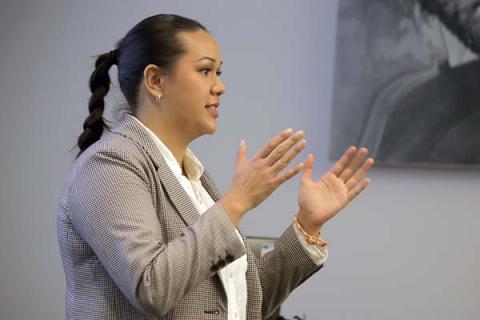
The Department of Communication Honors Program provides an opportunity for qualified students to pursue a more challenging and in-depth study of the field. To help prepare for graduate school or a career that involves research in some way, honors students can conduct research under the supervision of a faculty advisor. Students who successfully complete the program receive Distinction in the Major upon graduation.
Eligible students are invited to apply during the spring quarter of their junior year. Students who meet the criteria listed below and have the consent of the instructor will be accepted into the program and will receive an approval code for Communication 180 during the fall quarter of their senior year.
1. Full major in Communication with junior class standing.
2. Minimum overall GPA of 3.50 and GPA of 3.50 in Communication major at the time of application and at the completion of the spring quarter of junior year.
The College of Letters & Science also offers an Honors Program; please visit their site for information and requirements.
Honors Coursework
There are two possible paths toward honors in our department:
Path 1: Students can conduct their own independent research project on a topic of their own choosing under the supervision of a faculty advisor. Students generate their own ideas and then complete their own research project and writing of their honors thesis under the guidance of a faculty advisor.
Path 2: Students working on a faculty member’s research project (e.g., as a 199RA) who take a significant leadership role in the idea generation, data collection and/or analysis, and who write a final manuscript that makes a novel or unique contribution to the faculty member’s project. In this path, it is allowable for the faculty advisor and student to generate an idea together, but in that case the student must lead the remainder of the project – including writing the final paper – with input from the advisor to qualify for Distinction in the Major.
As part of the program, honors students take a four-unit Senior Honors Seminar (Communication 180) during the fall quarter of the senior year. The seminar is designed to introduce students to the process of conducting research in Communication. Basic steps in the research process are covered, such as defining an area of interest, conducting a literature review, and designing a study. Students also learn how to write a research proposal using the American Psychological Association Style Guide.
Students who receive a grade of either A or A- in Communication 180 will be qualified to enroll in 8 additional units of Senior Thesis Research during the next two quarters (4 units during the Winter quarter of Communication 181A and 4 units during the Spring quarter of 181B). These units involve independent work with student's faculty advisor and are designed to culminate in the Senior Thesis. However, any student who does not earn a grade of either A or A- in Communication 180 will not be allowed to continue with Communication 181A-B, although they will receive full credit for Communication 180. Please note that students are not able to enroll in COMM 199RA with their honors advisor while enrolled in COMM 181A-B as this would be giving duplicate credit for their honors work.
Honors students present their work to faculty, other honors students, and guests at a colloquium scheduled at the end of the senior year, and are acknowledged at the Annual Awards Ceremony.
Upon satisfactory completion of required coursework and the thesis, students are recommended for graduation with Distinction in the Major.
Honors students are encouraged to apply for URCA research funding in early fall of their senior year. The grants offer competitive research funds of up to $750, to be used to cover any costs associated with their research projects. Applications are completed with the assistance of the COMM 180 instructor and include a detailed budget for how the funds will be used in the research project.
Senior Honors Students from Recent Years
(Please note that we are missing some students, titles, and advisors. If you know one of these, please email the Senior Honors Thesis Advisor, Dr. Gordon Abra, at gabra@comm.ucsb.edu).
2026
Honors Coordinators: Gordon Abra, Jennifer Gibbs
- Frances Jereb: Remembering Our Green Selves: Exploring Climate Attitudes Through Identity and Memorable Messages (Advisor: Lupita Madrigal)
- Annika Foley: Paws for Connection: The Role of Therapy Dogs in Enhancing Human Connection (Advisor: Robin Nabi)
- Samuel Liu: "Piecing the Night Together": Collective Sensemaking in College Nightlife Debriefs (Advisor: Jennifer Gibbs)
- Maya Smestad: Investigating the Impact of a Health-Modified Video Game on the Dietary Intentions and Behaviors of U.S. College Students (Advisor: Jiaying Liu)
- Gohan Huynh: Perslaysion: The Effects of the "Gay Voice" on Interpersonal Outcomes (Advisor: Norah Dunbar)
- Le Anh Metzger: Organizing in High-Stakes and High-Risk Situations: A Case Study of Immigration-Focused Rapid Response Networks (Advisor: Jennifer Kam)
- Alejandro (Jose) Mendoza: Echoes of Gaming: Auditory Influences on Cognitive Transfer Within a Visually Neutral and Interactive Digital Environment (Advisor: Walid Afifl)
- Jack Gibson: Does Exposure to Politically Centrist News Media Reduce Political Polarization? (Advisor: Muniba Saleem)
- Curren DeJonge: Navigating Limited Purview in Public Planning: How Local Planning Commissioners Process Information and Define the Scope of Their Work (Advisor: Norah Dunbar)
- Emma Chu: Eco-Conscious but Still Shopping: Gen Z and the Fast Fashion Paradox (Advisor: Jennifer Gibbs)
- Kimberlly Baldwin: It's All Abou Me! Self-Referential Processing and Cognitive Fatigue with Perceived vs. Objective Cognitive Resource Depletion (Advisor: Kristy Hamilton)
2025
Honors Coordinator: Gordon Abra
- Amitha Bhat: Analyzing Identification, Commitment, and Well-Being in Student-Run Organizations (Gibbs)
- Sidney Cullinan: Hacking the Brain: Nature in Human Spaces (Liu)
- Robert Davis; Love, Loss, & Leverage (Dunbar)
- Shay Hawkes: Moral Violations, Emotion, and Political Cynicism (Lane)
- Lin Huang: Sweet Texting: Examining Dyadic Rapport in A.I.-Mediated Texting (Dunbar)
- Michelle (Mimi) Li: Political Grief (Lane)

2024
Honors Coordinator: Gordon Abra
- Alhees Bacharmal: Happiness and Intentions - A Study on Social Media Videos and Mental Health (Truscelli)
- Alexis Crisostomo: Cultivating Resilience Across Oceans & Communication Among U.S. Military Families During Parental Deployment (Merolla)
- Tintin Ding: Keep Students Safe: Evaluating Health Intervention Messages (Gibbs)
- Francesca Giannotta: Decoding the High: UCSB Students' Perceptions of Cocaine Usage (Truscelli)
- Zhukang Qin: Laughter's Role in Group Dynamics: Testing and Discovering Mediation Models of Group Cohesion and Influence (Reid)
- Jamie Sampson-Lizotte: Examining Factors Influencing Perceptions of Leadership Effectiveness and Satisfaction with Leadership (Gibbs)
- Ashley Wang: Global Perspectives on Commodity Feminism: A Qualitative Study of Cultural Variances in Advertising Impact on Consumers (Myers)
2023
Advisors: Gordon Abra and Jennifer Gibbs
- Ashley Avarado: Perceptions of Nonverbal Forms of Affect in Interaction between Lesbians
- Ruijie "Annie" Chen: How Do You Decide What to Buy? Consumers' Perceptions of Corporate Social Responsibility and Purchase Intentions
- Kylie Delaney: Do You Know Where You're Going? An Investigation of Artificial Intelligence & Critical Thinking
- Josh Freitas: Unsure about Lying: Examining the Role of Uncertainty and Closeness in Deceptive Communication Evaluations
- Lily MacMillan: Barriers to Entry: Interpersonal Communication in Attorney-Immigrant Relations
- Katie Posey: BeReal of BeFake: A Study of Authenticity in Social Media
2022
Advisors: Robin Nabi and Jennifer Gibbs
- Katherine Carmichael: Evaluations of Political Candidates’ Gendered
CharacteristicsImage

- Sophia Castro: Exclusivity Isn’t Cool Anymore: Plus-Size Model Representation in Retail Fashion Advertisements
- Freya Chu: How Do People Make Their Decisions in Investing by Evaluating the Credibility and Completeness of FinTech Companies
- Shannon Hollingsworth: Who Writes History? An Examination of Framing Theory in K-12 History Textbooks
- Michelle Lee: Beyond the Model Minority: Exploring the Impacts of the Model Minority Myth on Asian American Organizational Assimilation & Upward Mobility
- Melanie Liu: Consumer Behavior around the Minimalist Advertising Paradox
- Muyun Liu: Mapping #MeToo Discourse in China: A Discourse Analysis of Online Mobilizing Practices
- Leela Mogadam: The Effects of Trauma on Interpersonal Relationships: In Regard to Relational Maintenance, Relational Satisfaction and Attachment Style
- Elise Nguyen: Trust and Algorithmic Decision Making: The Influence of Perceived Risk and Control on Human Trust of Automated Systems
- Paola Portabales Mosquera de Barros: The Role of the Leader in Shaping Organizational Culture through Technology
- Jamaica Ty: Boba Liberal Activism and Its Relationship to the Group Identification and Structural Awareness of Asian Americans
- Cary Walker: Environmental Messages: Examining Message Modifications that Can Elicit More Pro-Environmental Behavior
- Haoning Zhu: How Media Framing in COVID-19 News Coverage Influences People’s Preventive Behaviors
2021
- Michaela N. Allen: Community is the Best Medicine: Coping with Racial Microaggressions Among Native American and Indigenous College Students
- Morgan Azevedo: “Team” vs. “colleagues”: Contrasting linguistic strategies in witness examinations
- Sofia Allegra Cavaness: “Protecting The Parks From The People, People From The Parks And The People From The People”: A Look Into The Identity And Culture Of California State Park Peace Officers
- Irene Chen: Understanding and Designing for Disaster Preparation on Social Media
- Claire Chung: Assessing the Effects of Musical Fit in Elaboration Likelihood Model: A Case of Music Lyrics
- Michelle Dalarossa: The Effects of Self-Construal and Group Cohesion on Intercultural Conflict Goal Preferences
- Micah Noah Haskins: An Offensive Against Failure: Promoting Error Disclosure Within the Workplace
- Siyun Li: Cosmopolitanism and Foreign-Language Films
- Melissa Ryan Lindberg: TikTok During Covid-19: Exploring the Impact of Participating in Body-Centric Trends on Body Image and Dietary Habits of College Students
- Myah Mahdise Mashhadialireza: COVID-19 & Telehealth: Interpersonal sensitivity and willingness to access therapy through specific media
- Kenny Morris: Right-To-Work Legislation Messaging in Labor Unions
- Chenxiao Niu: Does Family Communication Patterns Moderate the Association between Perceived Stigma by People with Eating Disorders and Social Support Preference?
- Annika Taylor Pearson: Group Talk: An Examination of Racial Intergroup Bias in Higher Education
- Mia Salas: Échale Ganas: Resilience and Coping within Queer Latine University Students
- Brandon Kyle Victor: Next Man Up: How Coaching Communication Perpetuates Hegemonic Masculine Beliefs in Athletes
- Jennifer W. Wang: Consumer Evaluations of Information Depth and Source in E-Commerce
- Lexie (Chenyue) Wang: Social Identification and Interpersonal Communication in Zoom Virtual Groups
2020
Advisors: Jennifer Gibbs and Scott Reid
- Kiara Actis: The Influence of Media Frames on Attitudes towards Online Regulation (Advisor, Scott Reid)
- Eva Bilange: Examining the Effects of Heuristic Cues on Expert and Non-Expert Individual Investors’ Evaluations of Online Stock Recommendations (Advisor, Andrew Flanagin)
- Andee Brooker: Political Agreeability behind Closed Doors: Politically Charged Language and Public Discourse on Integrative (Advisor, Scott Reid)
- Sevan Garibian: Mitigating Corporate Reputation Loss Following a Data Breach Using Image Repair Strategies (Advisor, Scott Reid)
- Shriya Ghai: Work-Related Emotional Communication Model of Burnout: An Analysis of Emotions in Human Resource Employees (Advisor, Karen Myers)
- Haley Mehlman: The Influence of Gender, Videos, and Sociosexual Orientation on Moral Judgements (Advisor, Jacob Fisher)
- Mika Kaczmar: Exploring the Relationship between University Students’ Willingness to Self-Disclose Mental Health Distress to a Healthcare Provider (Advisors, Jennifer Gibbs & Rachyl Pines)
- Reema Moussa: Initiating Virtual Collaboration among Tense Groups: An Online Intergroup Contact Approach (Advisor, Joe Walther)
- Jessica Pressman: Gauging Relational Investment across Various Computer Mediated Communication Platforms (Advisors Jennifer Gibbs and Matt Giles)
- Hudah Rana: The Effects of Gender Stereotypes about Intelligent Personal Assistants (IPAs) on a Product’s Perceived Ability and Likeability (Advisor, Jennifer Gibbs)
- Kelly Tong: Attached to Language: The Internal Working Model of Attachment Applied to the Phenomena of Language Brokering and Parentification (Advisor, Scott Reid)
- Alexis Voss: Men’s Use of Indirect Aggression as an Intrasexual Competition Strategy (Advisor, Scott Reid)
- Laurent Haoyu Wang: Cross-cultural Differences in Privacy Management among Adult Children and Their Parents on Social Media (Advisor, Miriam Metzger)
2019
Advisor: Professor Scott Reid
- Bianca Dalangin: Creativity and Fluctuating Facial Asymmetry: Predicting Male Short-Term Mating Success
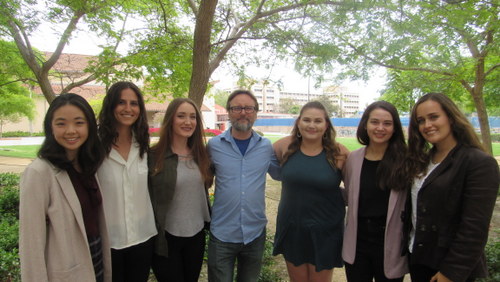
- Angelica Goetzen: Save It for Later: The Effect of Expected Later Access on the Ability to Recall and Act on Goal-Oriented Information
- Tanya Gosselin: It's Not Just Politics: The Effects of Ideological Rigidity on Immigration Policy Attitudes
- Kyla Jarrar: Social Media and Mental Health: The Role of Social Reputational Competition
- Isabelle Lee: "It's Okay, I Suck Too!": Interpersonal Effects of Self Deprecating Humor
- Haley Nolan: Social Media Use and Dating Strategies
- Cassidy Pyle: College Students’ Use of Facebook: Examining College Generational Status, Social Capital, and Academic Implications
2018
Advisor: Professor Scott Reid
- Ruby Callahan: An Evolutionary Explanation for the Communicability and Memorability of Stereotypes
Image
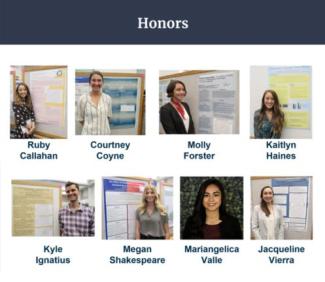
- Courtney Coyne: Sexual Functions of Sarcasm
- Molly Forster: Political Polarization: The Effects of Party Identity on Willingness to Accept Scientific Information
- Kaitlyn Hains: An Examination of Stereotype Threat on Biracials: The Moderating Effects of Arousal and Ethnic Identity
- Kyle Ignatius: A Comparison of Integrative Complexity and Emotionality in Political Blogs During the Obama and Trump Eras
- Megan Shakespeare: Political Moral Judgments and Double Standard Biases (Reid/Linz)
- Mariangelica Valle: Examining Latina/o College Students Reactions to Intragroup Marginalizing Messages (Reid/Kam)
- Jacqueline Vierra: YouTube Vlogging: The Effects of Vloggers Gaze and Viewer Neuroticism on Personal Connection and Product Endorsement
2017
- Dane Asato: Online Advertising Effectiveness: Ad Integration and Cognitive Load (Linz, Reid)
Image
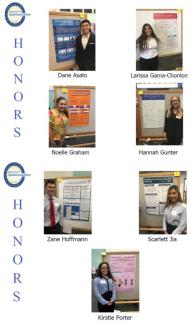
- Hannah Gunter: The Effectiveness of Transformational Leaders: Communicating Ingroup Identification Amidst Gender Bias (Reid)
- Larissa Gama-Chonlon: How Players Play: Kleptogamy in Human Relationships (Reid)
- Jai Miles: Differences in Perception Across Communication Channels (Dunbar/Adams)
- Noelle Graham: Is Drug Use a Costly Signal? A New Test of the Crazy Bastard Hypothesis (Reid)
- Zane Hoffman: The Diffusion of Data-Driven Marketing Technologies: Analyzing Organizations' Social Construction of their Attributes, 1990-2017 (Rice)
- Scarlett Jia: Life History, Sexual Hookups, and Self-Esteem (Reid/Linz)
- Kirstie Porter: Music, Emotion, and Motivation (Reid)
2016
- Lauren Antone: Exploring the Use of Behavioral Control Attempts in Interpersonal Relationships (Aldeis)
Image
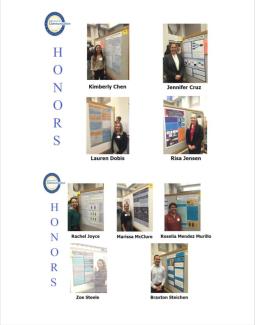
- Kimberly Chen: Predictors of Communication Apprehension (Linz)
- Jennifer Cruz: Testing Evolution Theory and Social Status in Male-to-Female Teammate Hostility (Abra)
- Lauren Dobis: The Role of Modern Surveillance on Behavior Modification and Self-Regulation (Abra)
- Rachel Joyce: Masculinity as a Persuasive Tool: The Impact of High vs. Low Levels of Masculinity on the Effectiveness of Sexual Violence Public Health Campaigns (Linz)
- Marissa McClure: The Effect of Previous Work Experience on Newcomer Assimilation and Organizational Identification (Abra)
- Roselia Mendez Murillo: Language Brokering Effects on Strength of Children's Ethnic Pride and Strength of Child-Parent Relationship (Abra)
- Emily Shapiro: Health Food Claims and Advertising: The Importance of Deception and Healthiness to the Consumer (Dunbar)
- Zoe Steele: Exploring Violent Video Games’ Effects on Objectification of Women and the Timing of Media Literacy Interventions as an Interaction Effect (Linz)
2015
Advisors: Dan Linz and Gordon Abra
- Christopher Chan: Designing for Motivation: Game Dynamics in Online Language Learning Platforms
Image

- Erika Frazer: Bilingual Self-Talk: The Effects of Language and Cultural Identification on School Performance
- Elizabeth Ivy: Consumer responses to Corporate Violations
- Julian Mueller-Herbst: Cultural Differences in Political Discussion
- Kimberly Ngo: Affirmative Consent in Sexual Contexts and Bystander Intervention Programs
- Christina Orzechowski: Management of Family Secrets Regarding Mental Illness
- Chinaza Osisioma: How Media Shapes Women's Self Esteem, Upward Social Comparisons and Internalization of the "Thin Ideal"
2014
Advisor: Dan Linz
- Sarah Bertolli: Emotional Intelligence, Relationship Satisfaction and Gender Differences
Image
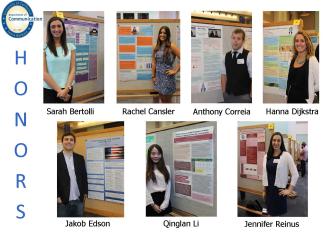
- Rachel Cansler: Stigma and Pathogen Avoidance Associated with Autism Spectrum Disorders
- Anthony Correia: Dominance and Enhancement in Social Hierarchies
- Hanna Dijkstra: Gender Differences in Pro-Environmentalism
- Jakob Edson: Attitudes Towards Online Privacy
- Qinglan Li: Gender Differences in Risk Perceptions of Online Shopping and Effects of Friend Recommendations
- Jennifer Reinus: Long Distance Relationships and Academic Success in First Year University Students
💡Apply for the Honors Program!
The application for the 2026-27 Honors Program is open until August 15, 2026!
Apply here:
https://forms.gle/b6XzZJMzrvR1Hvm19
Questions?
Contact comm-advising@ucsb.edu